
Transitioning from commerce classrooms or professional exam prep—such as Chartered Accountancy (CA), Company Secretary (CS), or Cost & Management Accountancy (CMA) to a real-world accounts desk can feel overwhelming. While textbooks teach you accounting principles, debits, and credits, employers look for freshers who can handle day-to-day compliance, accounting software, and financial reporting with minimal hand-holding.
Mastering the following practical skills will help you stand out in interviews and hit the ground running from day one.
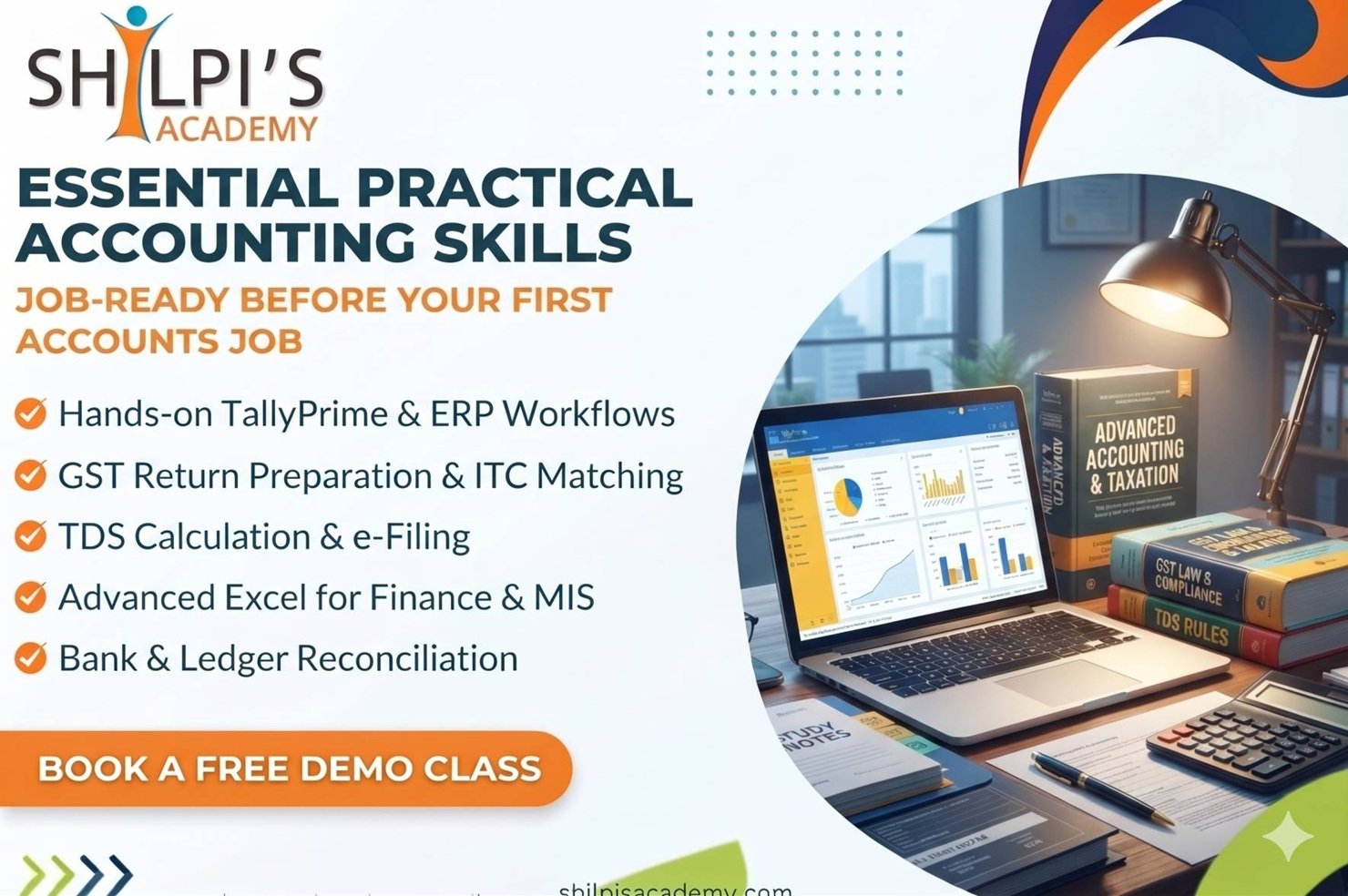
1. Hands-On Proficiency in Accounting Software (TallyPrime & ERPs)
Most small and mid-sized businesses in India rely on TallyPrime, while larger enterprises use Zoho Books, SAP, or Oracle. Knowing how to navigate these tools is non-negotiable.
-
Voucher Entry: Recording purchase, sales, payment, receipt, contra, and journal vouchers accurately.
-
Ledger & Group Creation: Mapping expenses, assets, and liabilities under the right accounting heads so financial statements stay clean.
-
Inventory & Cost Centres: Tracking stock movement, batch details, and department-wise expenses.
-
Shortcut Keys & Reports: Generating Trial Balances, Day Books, and Outstanding Receivables/Payables reports quickly.
2. GST Compliance & Return Filing Workflows
Goods and Services Tax (GST) is part of almost every daily accounting transaction. Employers expect freshers to understand both tax calculation and portal compliance—core areas covered across CA Intermediate and CMA Intermediate programs.
-
GST Invoicing & HSN/SAC Codes: Checking tax rates (CGST, SGST, IGST) and ensuring e-invoicing and e-way bill rules are followed.
-
GSTR-1 & GSTR-3B Preparation: Compiling outward supply summaries and calculating net tax liability.
-
ITC Reconciliation (GSTR-2B Matching): Matching purchase registers against GSTR-2B to ensure valid Input Tax Credit (ITC) claims and following up with vendors on missing invoices.
3. TDS Calculation, Deduction & Return Basics
Tax Deducted at Source (TDS) applies to routine business payments like rent, professional fees, contractor bills, and salaries.
-
Section Identification: Knowing common sections (such as 194C, 194J, 194I, and 194H) and applicable threshold limits.
-
Challan Payments: Generating challans and depositing deducted tax before monthly due dates to avoid interest penalties.
-
Quarterly Returns & Certificates: Assisting with Form 24Q/26Q filings and downloading Form 16/16A from the TRACES portal.
4. Microsoft Excel for Accounting & Financial Analysis
In almost every finance department, Excel is the primary workspace for reconciliations, MIS reports, and data verification.
-
Essential Formulas:
VLOOKUP/XLOOKUP,INDEX-MATCH,SUMIFS,COUNTIFS,IF, and text/date functions. -
Pivot Tables: Summarizing large transaction logs by vendor, month, or expense category in seconds.
-
Data Cleaning & Formatting: Removing duplicates, using conditional formatting to spot mismatches, and preparing clean printable sheets.
5. Bank & Ledger Reconciliation
Reconciliation ensures that the numbers in your accounting software match external records.
-
Bank Reconciliation Statement (BRS): Identifying uncleared cheques, bank charges, direct customer deposits, and timing differences between the cash book and bank statement.
-
Vendor & Customer Ledger Scrutiny: Confirming opening/closing balances, adjusting debit/credit notes, and flagging overdue receivables.
6. Accounts Payable (AP) & Accounts Receivable (AR) Management
Cash flow depends on how well a company tracks money coming in and going out.
-
Three-Way Matching (AP): Verifying the Purchase Order (PO), Goods Receipt Note (GRN), and Vendor Invoice before releasing payment.
-
Ageing Analysis (AR): Tracking pending customer invoices (0–30, 31–60, 61–90+ days) and sending timely payment reminders.
7. Payroll Processing & Statutory Deductions
Even if HR handles attendance, the accounts team calculates net salaries and statutory compliance—skills that complement corporate compliance studies in CS Executive.
-
Salary Structure Breakdown: Understanding Basic, HRA, allowances, reimbursements, and overtime.
-
Statutory Compliance: Computing Provident Fund (PF), Employee State Insurance (ESI), Professional Tax (PT), and salary TDS.
8. Year-End Closing & Audit Readiness
At the end of the financial year, accounts teams prepare books for statutory and tax audits.
-
Adjusting Entries: Recording depreciation, prepaid expenses, accrued income, and outstanding expense provisions.
-
Document Vouching & Filing: Maintaining organized digital and physical files of invoices, bank statements, and tax challans so auditors can verify entries smoothly.
How to Build These Skills Before Applying
-
Practice on Real Scenarios: Create a dummy company in TallyPrime or Zoho Books and enter a full month of sample purchases, sales, bank entries, and GST adjustments.
-
Build Excel Mini-Projects: Practice reconciling two sample datasets (e.g., purchase register vs. GSTR-2B) using
XLOOKUPand Pivot Tables. -
Learn Through Structured Mentorship: Pairing your commerce degree or professional exam prep with guided training bridges the gap between classroom theory and live office workflows. Explore more career and exam strategies on the Shilpi’s Academy Blog.
TallyPrime is the best starting point for freshers in India, as most SMEs, CA firms, and mid-sized companies use it for daily bookkeeping and GST compliance. Once you understand voucher entries, ledgers, and basic reports in Tally, transitioning to cloud tools like Zoho Books or ERPs like SAP becomes much easier.
Theoretical knowledge builds your conceptual base, but employers strongly prefer candidates who can execute practical tasks such as GST return preparation (GSTR-1 and GSTR-3B), GSTR-2B reconciliation, TDS calculation, and bank reconciliation without heavy supervision. Combining your CA Foundation or CSEET Foundation with hands-on training significantly improves your chances of getting hired.
You do not need complex coding or macros as a fresher, but you should be comfortable with data-handling tools used daily in finance teams. Focus on mastering VLOOKUP/XLOOKUP, SUMIFS, IF formulas, Pivot Tables, conditional formatting, and basic data cleaning for reconciliations and MIS reports.
Interviewers frequently test candidates on journal entries for GST and TDS transactions, Bank Reconciliation Statement (BRS) adjustments, differences between GSTR-1, GSTR-2B, and GSTR-3B, basic TDS sections (like 194C, 194J, and 194I), and hands-on tasks in TallyPrime or Excel.
With structured, hands-on practice using real-world business scenarios, a commerce student or graduate can build strong, job-ready proficiency in TallyPrime, GST, TDS, payroll, and Excel within 2 to 3 months.