
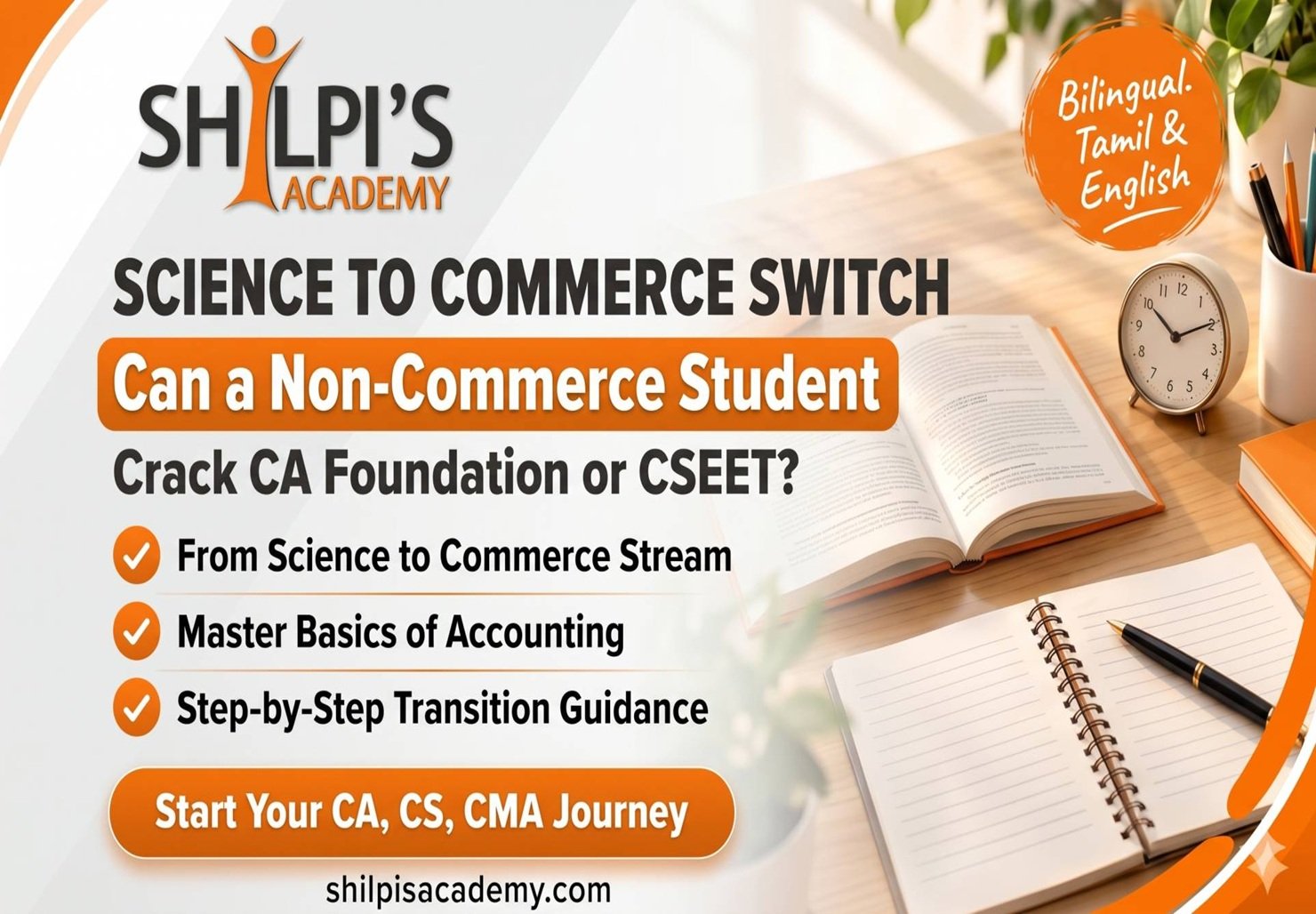
Every year, thousands of Class 12 Science students realize that engineering or medicine isn’t the path they want to pursue. If you are considering a science-to-commerce switch and eyeing prestigious professional courses like Chartered Accountancy (CA) or Company Secretary (CS), one question likely tops your mind: Can a non-commerce student actually crack CA Foundation or CSEET?
The short answer is yes; not only can you crack them, you actually have a few hidden advantages.
Both the Institute of Chartered Accountants of India (ICAI) and the Institute of Company Secretaries of India (ICSI) welcome students from all academic streams. Every year, hundreds of students from Physics, Chemistry, Mathematics (PCM), and Biology (PCB) backgrounds clear these exams on their very first attempt with structured guidance from institutes like Shilpi’s Academy. Here is everything you need to know about leaping successfully.
1. Eligibility: Are Science Students Allowed?
Before diving into preparation, let’s clear up the official eligibility rules:
- CA Foundation Eligibility for Science Students: ICAI does not restrict entry to Science students. Anyone who has passed or appeared in Class 12 from a recognized board (Science, Arts, or Commerce) can register for the CA Foundation course. Furthermore, having Mathematics in Class 12 is not mandatory.
- CSEET Eligibility Criteria for Science Students: Similarly, ICSI allows any 10+2 pass or appearing student from any stream (except Fine Arts) to register for the CSEET programme as their gateway into the Company Secretary profession.
2. The “Science Student Advantage” Nobody Talks About
Many students worry that switching from science to commerce after 12th puts them two years behind their Commerce peers. While Commerce students know basic terminology, Science students bring distinct strengths to the table:
- Dominance in Quantitative Aptitude (CA Foundation): Paper 3 of CA Foundation features Business Mathematics, Logical Reasoning, and Statistics. If you are from a PCM background, topics like calculus, permutations, combinations, and probability will feel like a breeze compared to Class 12 competitive math.
- Analytical & Problem-Solving Mindset: Science trains you to understand why a formula works rather than blindly memorizing it. Accounting and Taxation rely heavily on logic, rules, and structured problem-solving.
- Rigorous Study Stamina: Preparing for science board exams or entrance tests builds high study endurance—a massive asset when tackling professional syllabi.
3. Where You Will Face Challenges (And How to Fix Them)
The primary hurdle for CA Foundation for science students and CSEET for non-commerce students is Accounting. Under the updated exam patterns, both CA Foundation (Paper 1) and CSEET (Paper 2: Fundamentals of Accounting) test foundational accounting in a descriptive, written format.
Because you haven’t studied Class 11 and 12 Accountancy, terms like Debit, Credit, Journal Entries, Depreciation, and Balance Sheets will look completely foreign at first.
The Fix: Do not try to read entire Class 11 and 12 NCERT textbooks from cover to cover. Spend just 10 to 15 days before your main classes start learning the “Golden Rules of Accounting” and basic business vocabulary (Assets, Liabilities, Capital, Revenue, and Expenses). Once the base is clear, CA Foundation and CSEET instructors teach accounting from the ground up.
4. CA Foundation vs. CSEET: Which Should You Choose?
If you are weighing CA vs CS to decide which path suits your transition best, compare their core focus areas:
- CA Foundation (ICAI): Ideal for students who enjoy numbers, financial analysis, auditing, and taxation. The exam covers four subjects—Accounting, Business Laws, Quantitative Aptitude (Math, Stats, and Logical Reasoning), and Business Economics—eventually leading to CA Intermediate and Final.
- CSEET (ICSI): Best suited for students who prefer reading, corporate governance, regulatory compliance, and legal frameworks. Under the revised offline pattern, CSEET tests four papers—Business Communication, Fundamentals of Accounting, Economic & Business Environment (all three descriptive), and Business Laws & Management (OMR-based MCQs)—unlocking admission to the CS Executive programme.
(Note: Both exams require a minimum of 40% marks in each individual paper and 50% in overall aggregate to pass.)
5. Step-by-Step Strategy to Clear on Your First Attempt
If you are wondering how to prepare for CA Foundation without a commerce background or structure your 30-day CSEET study plan, follow this 4-step roadmap:
- Master the Vocabulary First: Dedicate your first two weeks exclusively to understanding basic financial and legal words. When you know what a Debtor, Creditor, or Contract actually means in the real world, lectures make 10x more sense.
- Focus on Conceptual Clarity in Accounts: Don’t memorize journal entries. Ask why an account is being debited or credited. Practice handwritten ledger posting and balance sheet preparation daily.
- Leverage Your Strengths for Aggregate Marks: Since you need 50% overall to pass, use high-scoring subjects to pull up your total. For CA students, Quantitative Aptitude and Business Economics can easily fetch 75+ marks. For CSEET students, Business Communication and Business Laws & Management are prime scoring areas.
- Practice Descriptive Answer Writing: Both ICAI and ICSI evaluate structured presentation. Attempt timed CSEET mock tests and CA Foundation practice papers to master step-by-step accounting solutions and point-wise legal answers.
FAQs:
Yes. Neither ICAI nor ICSI requires Mathematics in Class 12 to register for CA Foundation or CSEET. While CA Foundation includes a Quantitative Aptitude paper covering basic business mathematics, statistics, and logical reasoning, the math level is based on Class 10–12 fundamentals and can be mastered with consistent practice. CSEET does not have a dedicated mathematics paper at all.
CA Foundation is moderately challenging, but not significantly tougher for Science students than for Commerce students. Science students typically excel in Quantitative Aptitude and logical analysis, needing extra effort mainly in Paper 1 (Accounting) during the first few weeks. With 4 to 6 months of structured preparation, non-commerce students regularly clear it on their first attempt.
It takes roughly 10 to 15 days of focused study to learn the foundational rules of accounting (such as Debit/Credit rules, Journal Entries, and Trial Balances) before starting the main CA Foundation or CSEET syllabus. You do not need to study the entire Class 11 and 12 commerce textbooks—just focus on core terminology and basic accounting concepts.
CSEET is generally considered slightly more approachable at the entry level because its syllabus emphasizes business communication, management, corporate environment, and foundational accounting, whereas CA Foundation dives deeper into complex accounting adjustments and quantitative math. Your choice should depend on whether you want a career in finance and audit (CA) or corporate law and governance (CS).
No formal bridge course is required. Both ICAI and ICSI design their entry-level study modules assuming students come from diverse academic streams. If you want personalized mentorship, bilingual support, and foundation-level concept building, you can contact Shilpi’s Academy or attend free demo classes before starting your batch.